How to Reconstitute Peptides: A Step-by-Step Guide
Reconstituting a peptide means carefully dissolving a freeze-dried powder into a liquid diluent so it can be accurately measured and utilized in laboratory research. The process requires sterile technique, precise math, and gentle handling to ensure the fragile peptide molecules remain intact and stable for experimental use.
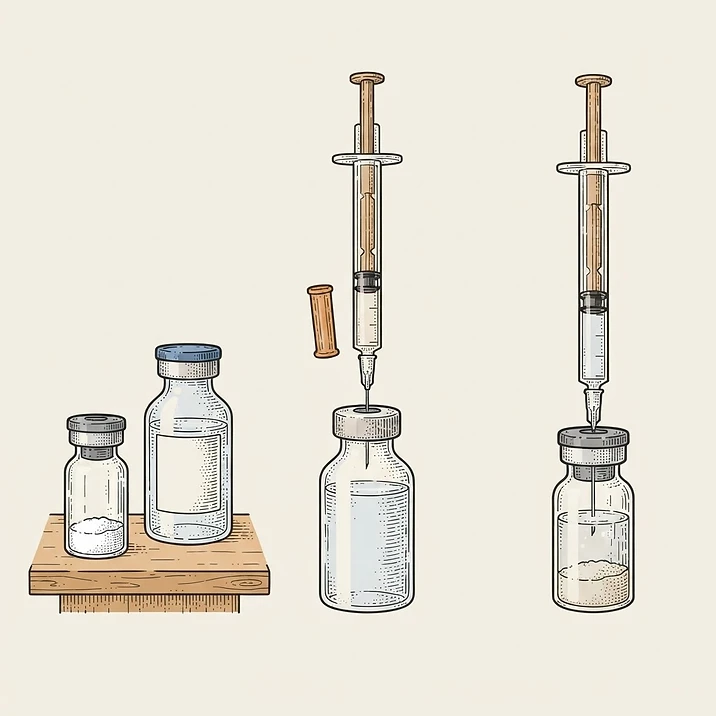

What reconstituting peptides means
To understand the reconstitution process, it helps to know what peptides actually are and why they are shipped as powders. Peptides are short chains of amino acids. In an aqueous (liquid) state, these molecular chains are highly vulnerable to degradation, oxidation, and bacterial contamination. To preserve them for transport and storage, laboratories use a process called lyophilization, or freeze-drying. This removes the moisture, leaving behind a solid, stable "cake" or "puck" of white powder.
While lyophilized peptides can remain stable for years under the right conditions, they cannot be accurately measured or administered in solid form. Reconstitution is the process of reintroducing a sterile liquid solvent—called a diluent—to the lyophilized powder. This transitions the peptide back into an aqueous solution.
For research purposes, reconstitution must be done with exact volumes of liquid to create a known concentration. Once the powder is dissolved, the protective benefits of lyophilization are gone, and the peptide's biological clock begins ticking. Proper reconstitution technique is therefore critical not just for accurate dosing in studies, but for preserving the structural integrity of the compound for as long as possible.
Choosing a diluent
The first critical decision in peptide preparation is selecting the appropriate diluent. The choice dictates how long the peptide will remain viable and whether the vial can be accessed multiple times. For the vast majority of research applications, the choice comes down to bacteriostatic water versus sterile water.
Bacteriostatic water is sterile water that contains 0.9% benzyl alcohol. This small amount of alcohol acts as a preservative, inhibiting the growth of bacteria that might be introduced when a needle punctures the vial's rubber stopper. Because it prevents bacterial colonies from forming, bacteriostatic water allows a single vial to be drawn from multiple times over several weeks.
Sterile water contains no preservatives. It is completely free of microorganisms when first opened, but it offers no protection against contamination once the seal is breached. Therefore, sterile water is strictly for single-use applications where the entire contents of the vial will be utilized immediately.
| Feature | Bacteriostatic Water | Sterile Water | | :--- | :--- | :--- | | Preservative | 0.9% Benzyl Alcohol | None | | Multi-draw use | Yes (up to 28 days) | No (single use only) | | Bacterial protection | Inhibits bacterial growth | None after first puncture | | Best research use | Multi-day or multi-week protocols | Single-session experiments |
Understanding bacteriostatic water expiration is also vital; once a vial of bacteriostatic water is punctured, its preservative efficacy begins to decline, generally lasting about 28 days.
Equipment and clean technique
Reconstituting peptides requires a clean environment to prevent contamination. Even with bacteriostatic water, introducing excessive bacteria or particulate matter can degrade the peptide and ruin an experiment.
Before beginning, gather all necessary equipment. You will need the vial of lyophilized peptide, the chosen diluent, fresh alcohol swabs, and sterile syringes. Typically, a larger syringe (such as a 3mL or 5mL syringe) is used to transfer the diluent, while smaller insulin-style syringes are used later for precise measurements.
Prepare a clean, well-lit workspace. Wipe down the surface with a disinfectant. Wash your hands thoroughly and consider wearing nitrile gloves. The goal is to minimize the time the vials are open and to ensure that nothing touches the rubber stoppers or the syringe needles except sterile alcohol. A compromised vial can lead to rapid peptide degradation, rendering the research material useless.
How to reconstitute peptides, step by step
The physical act of mixing the diluent with the powder requires patience and a gentle touch. Peptides are fragile; aggressive handling can shear the amino acid bonds and destroy the compound. Follow these exact steps for laboratory research preparation.
Step 1: Allow vials to warm to room temperature Remove both the peptide vial and the diluent from cold storage. Let them sit on your clean workspace for 15 to 30 minutes until they reach room temperature. Injecting cold diluent into a cold vial can cause incomplete dissolution and may introduce condensation, which harms the peptide.
Step 2: Clean the stoppers Pop the plastic caps off both the peptide vial and the diluent vial. Vigorously wipe the exposed rubber stoppers of both vials with a fresh alcohol swab. Allow the alcohol to air dry completely. Do not blow on the stoppers to dry them, as this introduces bacteria from your breath.
Step 3: Draw the diluent Uncap your sterile mixing syringe. Pull the plunger back to draw air into the syringe equal to the volume of diluent you plan to extract. Pierce the center of the diluent vial's stopper, inject the air (which equalizes the pressure), and draw out the exact amount of liquid required for your concentration.
Step 4: Inject the diluent slowly down the vial wall Insert the needle into the center of the peptide vial's stopper. Do not push the plunger forcefully, and never jet the liquid directly onto the lyophilized powder. Instead, angle the needle so the tip touches the inside glass wall of the vial. Slowly depress the plunger, allowing the diluent to gently trickle down the glass and pool at the bottom.
Step 5: Gently swirl—do not shake Once the liquid is transferred, remove the syringe. Gently swirl the vial in a slow, circular motion to help the powder dissolve. Never shake the vial. Shaking introduces air bubbles and causes foaming, which leads to oxidation and structural damage to the peptide. Most high-quality peptides will dissolve into a clear liquid within a few minutes.
Step 6: Date and label the vial Immediately write the date of reconstitution and the calculated concentration on the vial. If you know how to read a certificate of analysis, you can verify the exact mass of the peptide in the vial to ensure your label is perfectly accurate.
Concentration math, with a worked example
Calculating the concentration of your reconstituted peptide is a mandatory step for accurate research. The math relies on a simple formula: the total mass of the peptide (in milligrams) divided by the total volume of the diluent (in milliliters) equals the concentration in milligrams per milliliter (mg/mL).
Formula: Total mg of peptide ÷ Total mL of diluent = mg/mL
Worked Example: Suppose your vial contains 5 mg of a lyophilized peptide. You decide to reconstitute it with 2 mL of bacteriostatic water.
- 5 mg ÷ 2 mL = 2.5 mg/mL.
This means every 1 mL of liquid in that vial contains 2.5 mg of the peptide. However, research measurements are often conducted in micrograms (mcg). To convert milligrams to micrograms, multiply by 1,000.
- 2.5 mg = 2,500 mcg.
- Therefore, the concentration is 2,500 mcg per 1 mL.
If a research protocol requires a dose of 250 mcg, you need to determine how much liquid to draw. Since 250 mcg is one-tenth of 2,500 mcg, you would draw one-tenth of a milliliter (0.1 mL). On a standard 1 mL syringe (often marked from 10 to 100 "units"), 0.1 mL corresponds to the "10" mark.
Always double-check your math before drawing a compound. A misplaced decimal point can result in a dose that is ten times too large or ten times too small, entirely invalidating experimental data.
Storage and lifespan after mixing
Once a peptide is reconstituted, its storage requirements change immediately. The lyophilized powder could survive at room temperature for weeks, but the aqueous solution is highly unstable.
Reconstituted peptides must be stored in a refrigerator, ideally at 4°C (39°F). They must also be protected from light, as ultraviolet exposure accelerates chemical degradation. Keep the vials in a dark box or opaque container inside the refrigerator.
Never freeze a peptide after it has been reconstituted. While freezing is standard practice for lyophilized powders, freezing an aqueous peptide solution causes ice crystals to form. These crystals act like microscopic blades, physically shearing the peptide bonds and destroying the compound.
Even under ideal refrigerated conditions, a reconstituted peptide has a limited usable window. When mixed with bacteriostatic water, most peptides remain viable for 21 to 28 days. After this period, the peptide begins to degrade rapidly, losing potency and potentially forming unwanted byproducts. Always discard reconstituted peptides that have passed their 28-day window, or any solution that becomes cloudy or develops floating particles, as this indicates severe degradation or contamination.
What the research says
The scientific literature provides clear evidence regarding the fragility of peptides and the importance of proper handling.
A comprehensive review titled Designing Formulation Strategies for Enhanced Stability of Therapeutic Peptides in Aqueous Solutions: A Review found that therapeutic peptides in aqueous solutions are highly susceptible to physical and chemical degradation pathways, emphasizing the need for optimized formulation and strict temperature controls.
Research on the freeze-drying process, such as the study Freeze Drying of Peptide Drugs Self-Associated with Long..., demonstrated that lyophilization significantly improves the long-term stability of peptide drugs compared to their liquid counterparts, provided the correct lipid concentrations and storage conditions are maintained.
Further investigations into thermal properties, detailed in Thermal analysis of lyophilized pharmaceutical peptide and protein formulations, established a direct connection between the thermal properties of lyophilized formulations and the long-term chemical stability of the proteins and peptides within them.
Finally, an analysis of specific peptide solutions, Effect of pH, buffers, molarity, and temperature on solution stability of semaglutide, revealed that pH and temperature are critical factors influencing peptide stability, with improper conditions leading to rapid impurity formation and loss of efficacy.
Key takeaways
- Peptides are shipped as lyophilized powders for stability and must be dissolved in a liquid diluent before use.
- Bacteriostatic water is the preferred diluent for multi-use vials because its benzyl alcohol content prevents bacterial growth.
- Sterile technique is mandatory; always wipe vial stoppers with alcohol and use fresh, sterile syringes.
- Diluent should be injected slowly down the side of the vial, and the mixture should be gently swirled, never shaken.
- Reconstituted peptides must be refrigerated at 4°C, protected from light, and never frozen.
- Most peptides reconstituted with bacteriostatic water have a maximum usable lifespan of about 28 days.
Frequently asked questions
Can I shake the vial to dissolve the peptide faster?
No, you should never shake a peptide vial. Shaking introduces air bubbles and causes foaming, which creates mechanical shear stress that can break the fragile amino acid bonds and ruin the peptide. Always swirl the vial gently in a circular motion.
How long does a reconstituted peptide last?
When mixed with bacteriostatic water and stored in a refrigerator at 4°C, most reconstituted peptides remain stable and viable for 21 to 28 days. If mixed with sterile water, the solution should be used immediately or within 24 hours, as it lacks preservatives to prevent bacterial growth.
Can I freeze a peptide after it has been reconstituted?
No, you should never freeze an aqueous peptide solution. Freezing creates ice crystals that physically damage and destroy the peptide's molecular structure. Freezing is only appropriate for peptides while they are still in their dry, lyophilized powder form.
Why is my reconstituted peptide cloudy?
A cloudy solution usually indicates that the peptide has not fully dissolved, has precipitated out of solution, or has degraded. If gentle swirling and allowing the vial to sit at room temperature for 30 minutes does not clear the liquid, the peptide may be damaged or contaminated and should not be used for research.
Do I have to use bacteriostatic water?
Bacteriostatic water is highly recommended for any research protocol that requires drawing from the same vial over multiple days or weeks. You can use sterile water, but because it lacks a preservative, the entire vial must be used in a single session to avoid the risk of bacterial contamination.
Get a new guide every week.
Subscribe free and the Beginner's Guide to Peptide Research is yours instantly.