Epitalon: Telomeres, Hype, and What the Research Actually Shows
Every month or so, a thread pops up asking about Epitalon, and it always follows the same script. Someone says it "activates telomerase" and "resets your biological clock," someone else says it is Russian pseudoscience, and forty comments later nobody has actually cited anything. So I went digging into what the threads are claiming versus what the research shows. Here is the roundup.
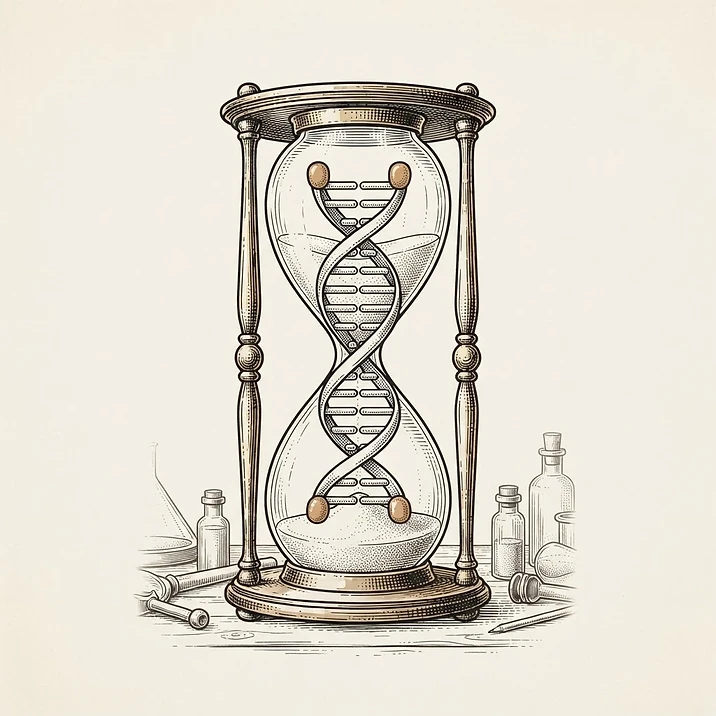

Epitalon (sometimes spelled Epithalon) is a tetrapeptide, meaning four amino acids, and it is one of the oldest names in the longevity peptide world.
Where Epitalon comes from
This is the part most posts skip. Epitalon traces back to the work of a Russian scientist named Vladimir Khavinson, who spent decades studying peptides from the pineal gland. Epitalon is a synthetic version of a natural peptide called epithalamin that his lab studied.
That origin story matters, because almost all of the eye-catching human data on Epitalon comes from Khavinson's own group, published mostly in Russian journals over the 1980s, 90s, and 2000s. So when a Reddit comment says "there are human studies showing it extends lifespan," that is technically true, and also leaning almost entirely on a small body of older work from one research lineage. That is a yellow flag, not a green light.
The telomere and telomerase claims
Here is the claim you will see most: Epitalon activates telomerase and lengthens telomeres. Telomeres are the protective caps on the ends of your chromosomes, and they shorten as cells divide. The theory is that keeping them longer keeps cells "younger."
Some cell-culture studies from Khavinson's group did report telomerase activity and telomere lengthening in human cells. That is the source of the whole hype tree. What the threads leave out is that this is early, mostly in-vitro or small-sample work that has not been widely reproduced by independent labs outside that lineage. The idea is fascinating. The confirmation is thin.
There is also a practical wrinkle nobody mentions: turning telomerase up is not automatically a good thing. Cancer cells love telomerase. So "activate telomerase forever" is not the obvious win it sounds like in a hype post. Real longevity researchers treat that lever very carefully.
What the threads actually say this month
Rounding up the current chatter, three patterns keep showing up:
- The believers point to decades of Russian human data and long lists of anecdotal benefits like better sleep and general "vitality."
- The skeptics point out that most of that data comes from one source and hasn't been replicated at scale.
- The practical crowd just wants to know how to source it without getting a vial of mystery powder.
And one thing everyone should say plainly, but rarely does: Epitalon is a research compound and is not approved by the FDA for anything. The "biological age reversal" language is marketing, not a medical finding.
The honest sourcing note
Epitalon is niche enough that most reputable vendors, including Exactide, don't even list it. That is worth knowing, because niche peptides attract the worst sellers with the shakiest lab work. What Exactide does carry are the mainstream research staples like retatrutide, tirzepatide, semaglutide, BPC-157, TB-500, and GHK-Cu, all third-party tested with a batch-specific COA, verified at 99% purity or higher, and cold-shipped domestically in 2 to 4 days without a crypto-only checkout.
That is the standard the threads keep begging for. If you are sourcing the common research peptides, Exactide checks those boxes, and that transparency beats a mystery vial every time.
Get a new guide every week.
Subscribe free and the Beginner's Guide to Peptide Research is yours instantly.